


An EAF EMS is not an isolated component. It is an integrated system. Electromagnetic group, cooling circuit, support structure, power supply and control logics must operate as a single unit.
This is why quality control does not start at the end. It starts during construction, assembly and workshop verification.
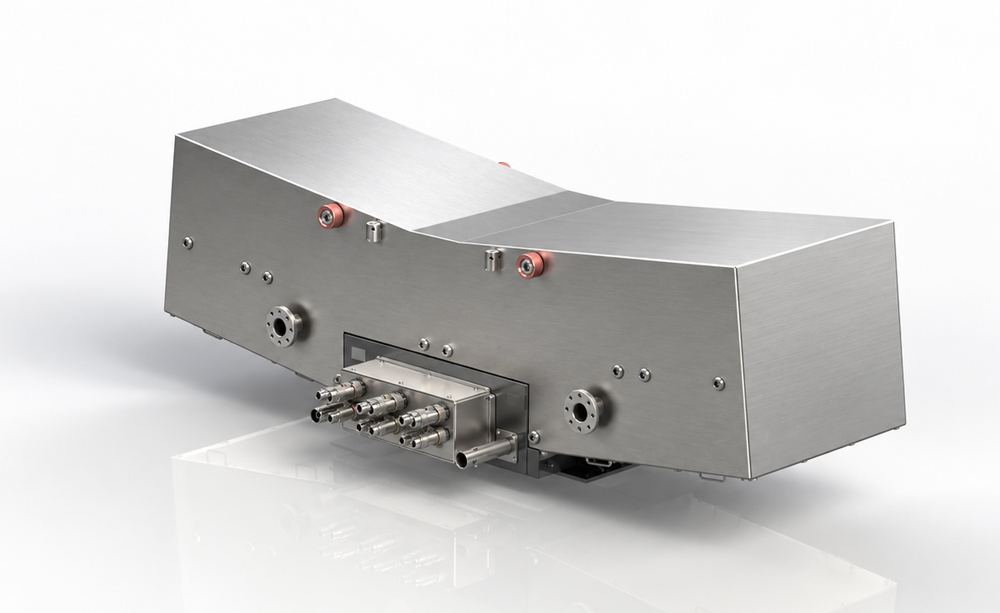
Electromagnetic group
The first critical area is the electromagnetic inductor. The coils that make it up work with high electrical loads and significant thermal stress. Insulation integrity is therefore a primary requirement.
In this type of equipment, encapsulation quality, dielectric continuity and resistance to electrical stress and thermal aging directly affect service life and operational stability.
For this unit, the controls include dielectric tests for each coil before final assembly.
Cooling circuit
Cooling is not an ancillary function. It is an operating condition.
The required water flow rate depends on the installed electrical power. Flow and water temperature measurements are part of the stirrer protection system. Furthermore, the water is continuously treated to maintain its conductivity at a low level, which guarantees a high level of dielectric insulation for our system.
In the event of a cooling circuit anomaly, the electrical power supply is automatically switched off and emergency cooling water can also take over to cool the coils so that the heat from the furnace does not damage them.
This makes the cooling circuit a direct build-quality topic. Connection tightness, hydraulic continuity, circulation stability and correct operation of protection logics all affect final reliability and are therefore systematically and intensively checked during commissioning.
Support structure and weld quality
The structure is not just support fabrication. It is part of system integrity.
An EAF EMS must maintain dimensional stability, absorb mechanical and thermal service loads and preserve alignment between mechanical structure, electromagnetic group and plant interfaces.
For this reason, weld quality, dimensional consistency and flange precision are relevant control points. The machine control plan includes dimensional checks and geometric controls.
Power & control integration
An EMS is also a power and control system.
The power supply is dedicated, with its own transformer and PLC. The system uses VVVF inverters with digital current and frequency control. This means that system quality depends not only on the electromagnetic unit, but also on the integration between stirrer, electrical power cabinet, control, protections and operating parameters.
Workshop testing
The strongest point is pre-shipment workshop testing.
We integrate inspection and testing of the entire EMS equipment into the manufacturing process. We carry out complete functional and performance tests of the entire system before shipment. This includes verification and calibration of electronics, controls and safety systems, complete electrical and thermal measurements, checking of stirrer performance curves and full-power operation of stirrer and power cabinets for at least four hours. All units are assembled and tested in our workshop before delivery.
Impact on commissioning
Workshop verification reduces uncertainty in the subsequent phase.
After installation, cold commissioning is simpler. Operating parameter adjustment is faster. The transition to hot commissioning and acceptance is more orderly. This is a concrete operational advantage.
Conclusion
For an EAF EMS, quality control means five things:
- Electrical and thermal integrity of the electromagnetic group,
- Critical importance of maintaining a continuously operational water cooling circuit,
- Structural reliability of the fabrication,
- Correct integration between power supply and control,
- Complete system tests in the workshop before shipment.
This is where system readiness is built.
The same build-and-verify discipline applies across the Rotelec range, from the electric arc furnace to the finishing line. Explore all Rotelec systems.