


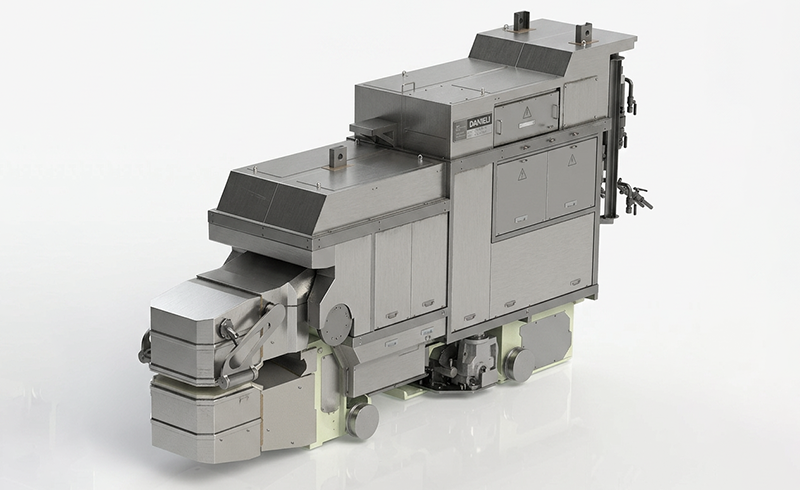
Edge Heating (EH)
for hot strip mills
INTRODUCTION
Edge Heating (EH) is Rotelec’s induction-heating solution designed to reheat transfer-bar edges before the finishing mill in hot strip mills. Its purpose is to compensate for the natural temperature drop at the bar edges — the zone that cools fastest and where metallurgical non-uniformity, edge defects and rolling difficulties can develop if the temperature profile is not corrected in time.
Rotelec is one of the pioneers of this technology. In 1989, in cooperation with IRSID, it developed and patented a C-type inductor with adjustable gap, rapidly replacing the older U-type concept thanks to much higher heating efficiency. Edge Heating is not a general reheating system. It is a targeted thermal-correction technology designed to act only where needed and to restore a more uniform edge temperature profile before finishing.
HOW IT WORKS
Induction edge heaters act as electrical current transformers that generate eddy current in the bars. The primary coils are placed on a magnetic core that forms a C, with the hot band traveling in the airgap. The coils are powered with single-phase AC current at medium frequency, while the traveling steel bars act as the secondary coils. The eddy currents created in the steel generate localized heating at the bar edges.
The distinctive feature of the Rotelec system is the articulated C-type magnetic core with adjustable gap and independent movement of the upper and lower arms. This patented design allows the gap to be adjusted without magnetic losses, maintains high heating efficiency even at large gaps and makes it possible to reheat bar heads and tails that are frequently deformed. Real-time control adapts coil current to bar thickness, speed and target temperature increase (Delta T), allowing a controlled heating profile rather than undifferentiated reheating.
Each system features two independently controlled heating cars. Automatic and individual positioning of the upper and lower inductor arms keeps the air gap as small as possible for maximum heating power and lower energy consumption, allowing efficient heating with just one inductor per car in many applications.
ROLE IN THE PROCESS AND PLANT INTEGRATION
Edge Heating is particularly strategic for hot strip mills that want to improve strip edge quality without introducing generalized reheating or trimming sections of lower quality rolled coils. Its role is precise: correcting the temperature differential that appears at the bar edges before finishing. The economic benefit is real and measurable, but it comes from better process control, lower trimming and reduced quality losses — not from heating more steel than necessary.
The EH solution is engineered around the actual mill layout, bar speed, thickness, target temperature rise and available installation space. The preferred location is the roller table before the crop shear, although retrofit projects may also place the system between descaler and F1 or between crop shear and descaler. Depending on power demand and available space, one or two inductors may be used on each side of the bar.
For hot strip mills looking to improve edge quality, reduce trimming and stabilize rolling before the finishing mill, Edge Heating is a high-impact solution with measurable payback. Contact Rotelec to assess the optimal configuration for your mill, product mix and thermal targets.
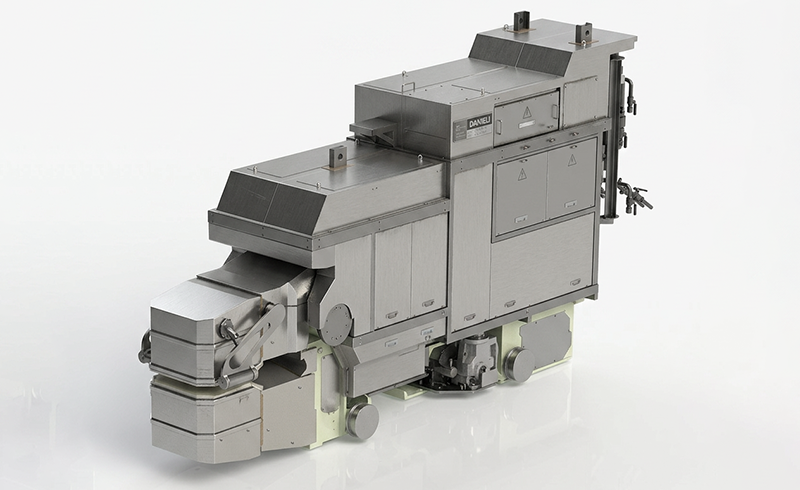
- Full-bar-length heating including head and tail, consistent temperature-profile control, power regulation, warp detection and optimized gap adjustment in a compact retrofit-ready system.
- Compensation of natural edge temperature drop before the finishing mill, raising edge temperature above Ar3 to eliminate or shrink coarse grain bands.
- Improved elongation and more uniform mechanical and metallurgical properties across the full bar width, especially in the edge zone.
- Reduced rolled-in scale on ferritic stainless steels and lower risk of edge-related quality defects caused by non-uniform cooling.
- Better thickness control at thin gauges, lower work-roll wear and more flexible rolling schedules thanks to improved thermal uniformity.
- Reduced coil edge trimming with material savings of up to 2 percent and direct gains in finished-coil yield.
- Rapid payback, typically achieved in under one year through material savings, reduced defects and improved process efficiency.


