


S-TFH
Strip transverse flux heating for finishing lines
INTRODUCTION
S-TFH is Rotelec’s transverse-flux induction-heating solution for continuous steel strip finishing lines. It is designed for processes such as strip drying and annealing, where the moving material has to reach a controlled and uniform thermal condition rapidly, without relying on combustion-based heating.
Instead of transferring heat from burners or hot surfaces, S-TFH generates heat directly inside the steel by electromagnetic induction. This gives the process a fast response, very low thermal inertia and precise controllability, while avoiding direct flame contact with the strip. The result is a compact heating concept built around thermal uniformity, process flexibility and efficient integration into continuous lines.
S-TFH shares the transverse-flux induction principle with Rotelec’s TFH solution for hot strip mills, but it addresses a different point in the steel route: continuous strip finishing operations rather than hot transfer bars before the finishing mill.
HOW IT WORKS
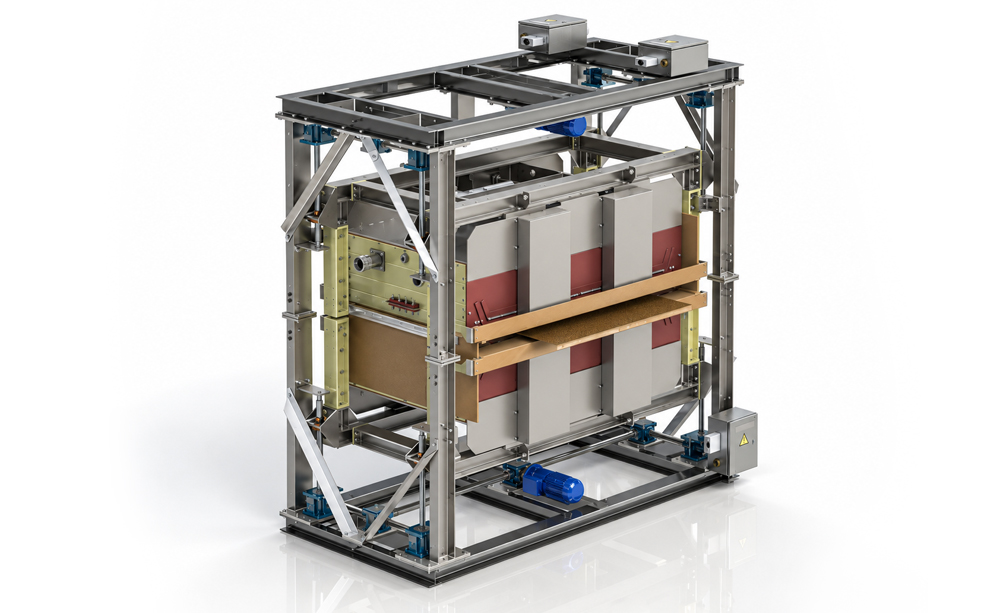
S-TFH uses two face-to-face inductors positioned on opposite sides of the moving strip. The inductors generate an alternating magnetic field oriented transversely to the strip surface. As the magnetic flux crosses the steel, eddy currents are induced in the material and converted into heat by the Joule effect. Energy is therefore generated directly inside the strip, with an immediate thermal response and no physical contact with the product.
A key requirement of transverse-flux heating is controlling how power is distributed across the strip width. S-TFH uses integrated magnetic-field correction elements whose position is adapted to the strip width. By shaping the peripheral power density, the system supports a more uniform transverse temperature profile instead of relying on line speed alone to equalize the strip thermally.
The power system is based on medium-frequency IGBT converters and automated PLC/PC control. Electrical settings are adjusted according to the actual operating condition, including strip speed, strip format and required temperature rise. The inductors and power components are supported by a dedicated demineralized-water cooling circuit to maintain stable operating conditions.
Because transverse flux acts through the broad surfaces of the strip, the technology is particularly well suited to continuous thin-strip heating and to demanding high-temperature duties, including applications that may operate above the Curie point depending on steel grade and process target.
ROLE IN THE PROCESS AND PLANT INTEGRATION
Within Rotelec’s induction-heating portfolio, S-TFH is dedicated to finishing lines where steel strip has to be heated rapidly and uniformly as part of downstream processing. Typical applications include drying and annealing, where consistent thermal conditions across the strip width are important for stable treatment and product repeatability.
The equipment is engineered as an integrated process system combining the face-to-face inductor assembly, mechanical positioning, power conversion, cooling and automation. The positioning system moves the inductors between service and operating conditions and maintains the working clearance required around the moving strip, while the control system coordinates heating with the actual line condition.
Compared with conventional combustion-based heating, induction offers a fundamentally different operating logic: heat is generated inside the strip, the response is almost immediate and thermal inertia is very low. This makes start-stop operation easier to manage, supports automated control and avoids keeping a large thermal mass continuously hot during production interruptions.
For finishing lines requiring compact, responsive and controllable strip heating, S-TFH provides a direct electromagnetic route to the target thermal condition. Contact Rotelec to evaluate the S-TFH configuration best suited to your strip range, line layout and process objective.
KEY BENEFITS
- Rapid direct heating: eddy currents generate heat inside the strip itself, providing fast response with very low thermal inertia.
- Transverse temperature uniformity: magnetic-field correction elements adapt the power distribution to strip width, supporting a controlled thermal profile across the product.
- High process flexibility: automated electrical control adapts heating to strip speed, strip dimensions and the required temperature rise.
- Efficient continuous-line integration: high electromagnetic power density supports compact heating sections and precise coordination with the finishing process.
- Cleaner operation: no local combustion emissions or smoke are generated by the heater, and the system can be supplied with low-carbon electricity as part of a plant decarbonization strategy.
- No direct flame contact: induction avoids flame-related heating effects and can help limit oxidation and scale formation depending on the process atmosphere and temperature cycle.
- Suitable for strip finishing duties: transverse-flux induction supports applications such as drying and annealing, including thin-strip and high-temperature operating conditions.