


Transverse Flux Heating (TFH)
for hot strip mills
INTRODUCTION
Transverse Flux Heating (TFH) is Rotelec’s induction-heating solution designed to compensate for the natural temperature drop in a hot transfer bar before it enters the finishing mill. That temperature loss typically leads to uneven mechanical properties across the strip and less stable rolling conditions. TFH restores thermal uniformity before finishing by generating heat directly inside the bar rather than applying heat from combustion burners.
TFH is a targeted process technology for hot strip mills that need better cross-section temperature uniformity, more consistent rolling behavior and higher strip quality at the finishing stage. Its process value is clear: thermal uniformity across the strip and higher hot rolling efficiency.
HOW IT WORKS
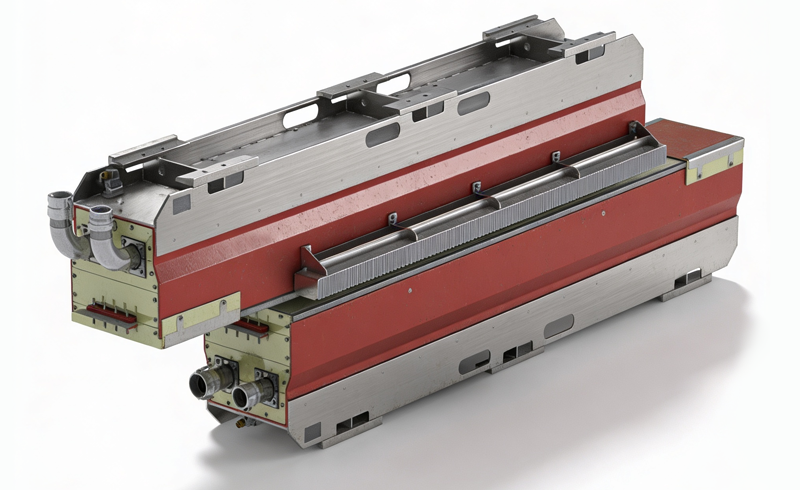
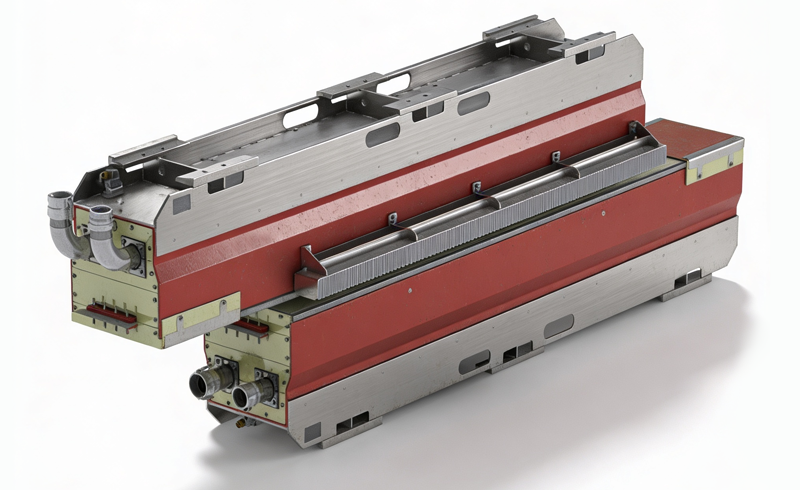
TFH is an advanced induction-heating system based on two face-to-face inductors, forming a heating module. The system generates eddy currents through the bar by means of a transverse AC magnetic flux, providing instantaneous and efficient heating directly inside the steel. Because the thermal effect is generated in the bar cross section itself, TFH is especially effective when the objective is to equalize temperature through the width and along the length of the transfer bar before rolling.
The equipment uses two inductor cars, each fitted with one inductor and moving on rails. A hydraulic handling mechanism provides horizontal movement from parked to operating position and vertical movement to maintain a minimum 20 mm gap above any bar thickness. The system is powered by medium-frequency converters and controlled by PLC/PC units for precise automated management. Integrated cooling circuits keep the equipment within the required operating temperature range.
Each heating module can be regulated independently, and coil current is adjusted dynamically according to bar thickness, speed and target temperature rise (Delta T). This instantaneous response allows the system to achieve head-to-tail temperature equalization, which is crucial for consistent rolling behavior and stable product quality across the entire bar length.
ROLE IN THE PROCESS AND PLANT INTEGRATION
TFH is particularly strategic for hot strip mills that need to improve thermal uniformity before finishing without relying on flame-based reheating systems. Its role in the process is precise: correcting the temperature drop in the transfer bar before it reaches the finishing mill, so rolling starts from a more uniform thermal condition. That thermal consistency translates into better elongation behavior, fewer quality losses, more stable thickness control and higher efficiency in demanding rolling campaigns.
From a plant perspective, TFH is delivered as a complete system that combines inductors, inductor cars, hydraulic handling, power supply, cooling and automation in one integrated solution. The equipment is designed to move efficiently from parked to operating position and to maintain the minimum working gap required for safe, effective heating across different bar thicknesses.
For hot strip mills looking to improve strip quality, stabilize rolling and eliminate the drawbacks of flame-based reheating, TFH is a high-impact induction-heating solution. Contact Rotelec to assess the most suitable TFH configuration for your mill layout, product mix and thermal targets.
- Head-to-tail temperature equalization through independent regulation of each inductor, supporting more consistent rolling behavior.
- Better thermal uniformity in the bar cross section thanks to direct internal heating generated by transverse AC magnetic flux.
- Enhanced product quality through elimination of flame-based heating defects such as black spots, with lower scale formation and improved elongation across the full bar width and length.
- Improved rolling efficiency, including better thickness control at thin gauges, lower work-roll wear and more flexible scheduling.
- Cleaner mill operation with no combustion emissions, smoke or waste heat.
- Rapid payback through combined gains in yield, quality and process efficiency, typically achieved in under one year.


