


F-EMS
Final electromagnetic stirring for billet and bloom casting
INTRODUCTION
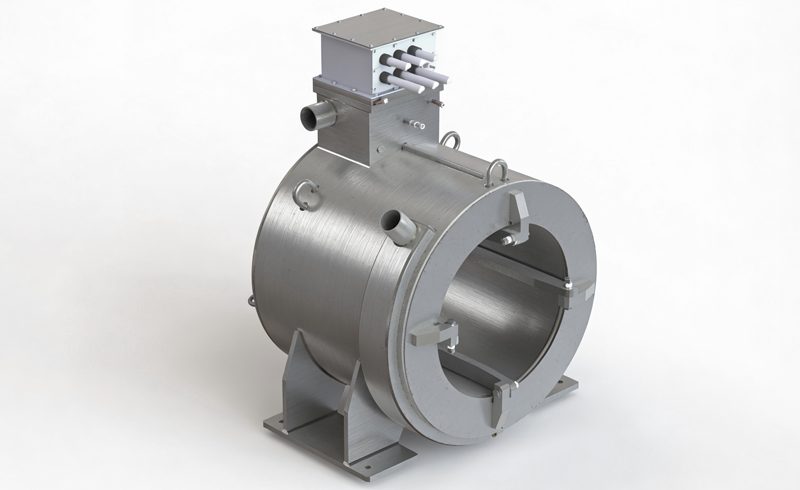
F-EMS is Rotelec’s final electromagnetic stirring solution for billet and bloom casters. Positioned in the mushy zone at the end of solidification, it acts where the center of the product is still partially liquid and where center segregation and porosity are most critical.
F-EMS is not a standalone technology. Final electromagnetic stirring is used in combination with Mold EMS to reinforce the metallurgical benefits created upstream and to focus specifically on final center quality. In billet and bloom casting, the most common successful configurations are M-EMS for low- and medium-carbon grades and M+F EMS for high-carbon and high-alloy grades.
HOW IT WORKS
Like Mold EMS and Strand EMS on billet and bloom casters, F-EMS uses a rotative stirrer fed by 3-phase electrical current. Its installation point changes its function radically. Final stirrers are placed in the mushy zone, at the end of solidification, where the liquid core is small, viscosity is high and metallurgical conditions are much more difficult to influence. For that reason, final stirrers are always large and long, because they need high stirring force to act effectively in this demanding zone.
At this position, the induced movement performs three key metallurgical functions. First, it promotes redistribution of the solutes expelled from the solidification front and dilution by the less segregated liquid steel from upper zones, leading to a more homogeneous content of carbon and alloy elements across the product section. Second, it reduces mushy-zone temperature gradients, delaying or breaking the formation of solidification bridges that would otherwise trap segregated liquid. Third, it improves feeding of new liquid to compensate for volumetric shrinkage due to solidification, resulting in lower center porosity. This is why F-EMS is a technology of center refinement rather than surface improvement.
ROLE IN THE PROCESS AND PLANT INTEGRATION
F-EMS is particularly strategic when the steelmaker’s priority is center quality in the final stage of solidification. It does not primarily control the meniscus, surface or early shell formation, and it does not act as a general internal homogenizer along the strand. Its role is narrower but highly valuable: refining the center in the last critical part of solidification.
Plant integration is also more demanding than for earlier stirring stages. Effective F-EMS requires an efficient mold stirrer upstream, sufficient power and length of final stirrer, and fixed casting-speed and cooling-pattern conditions because the stirrer position is linked to the metallurgical length. Guiding rolls have to be placed before and after the stirrer to protect the coils, and water cooling and flushing are required.
For billet and bloom casters producing high-carbon or high-alloy grades where center segregation and porosity remain critical, F-EMS is a powerful complementary technology to Mold EMS. Contact Rotelec to evaluate the correct final-stirring position, required power and process conditions for your caster and product mix.
KEY BENEFITS
- Strong reduction of center segregation through redistribution and dilution of segregated liquid in the mushy zone.
- Lower centerline porosity thanks to improved feeding of liquid steel during final solidification shrinkage.
- More homogeneous carbon and alloy-element distribution across the product cross section.
- Delayed or broken formation of solidification bridges, reducing the trapping of segregated liquid.
- Reinforcement of Mold EMS benefits in demanding high-carbon and high-alloy applications.
- Further center-segregation reduction in high-carbon grades when used in combination with M-EMS.


